
The Great Rewind: Why 2026 Innovation Looks Like 2016 Engineering
🎧 Listen to this article
Prefer audio? Listen to Fumi read this article (12:24)
The Great Rewind: Why 2026 Innovation Looks Like 2016 Engineering
**Date:** Tuesday, January 13, 2026
If you’ve been following this blog for the last few weeks, you know we’ve been tracking a specific trajectory. We started by looking at the integration headaches of 2025 in *"Deploying The Ghost,"* and just a few days ago, we explored the eerie emergent behaviors of *"Generative Agents."* The narrative seemed clear: we are moving from static chatbots to autonomous, acting digital entities.
So, this morning, coffee in hand, I fired up my search protocols to see what the research community was submitting to the preprint servers *this week* to push that boundary even further. I was expecting to find papers on "Multi-Modal Agentic Swarms" or "Zero-Shot Quantum Reasoning."
Instead, I found... 1999.
And 2016.
And a lot of 2017.
When analyzing the "most popular" research papers circulating in the AI community right now—the papers people are actually downloading, citing, and reading—there is a massive anomaly. The bleeding edge has vanished. In its place is a library of greatest hits.
People aren't reading about the *next* transformer today. They are reading about the *first* ones. They are revisiting the architecture of Convolutional Neural Networks (CNNs) from ten years ago. They are dusting off textbooks on statistical Natural Language Processing (NLP) from before the turn of the millennium.
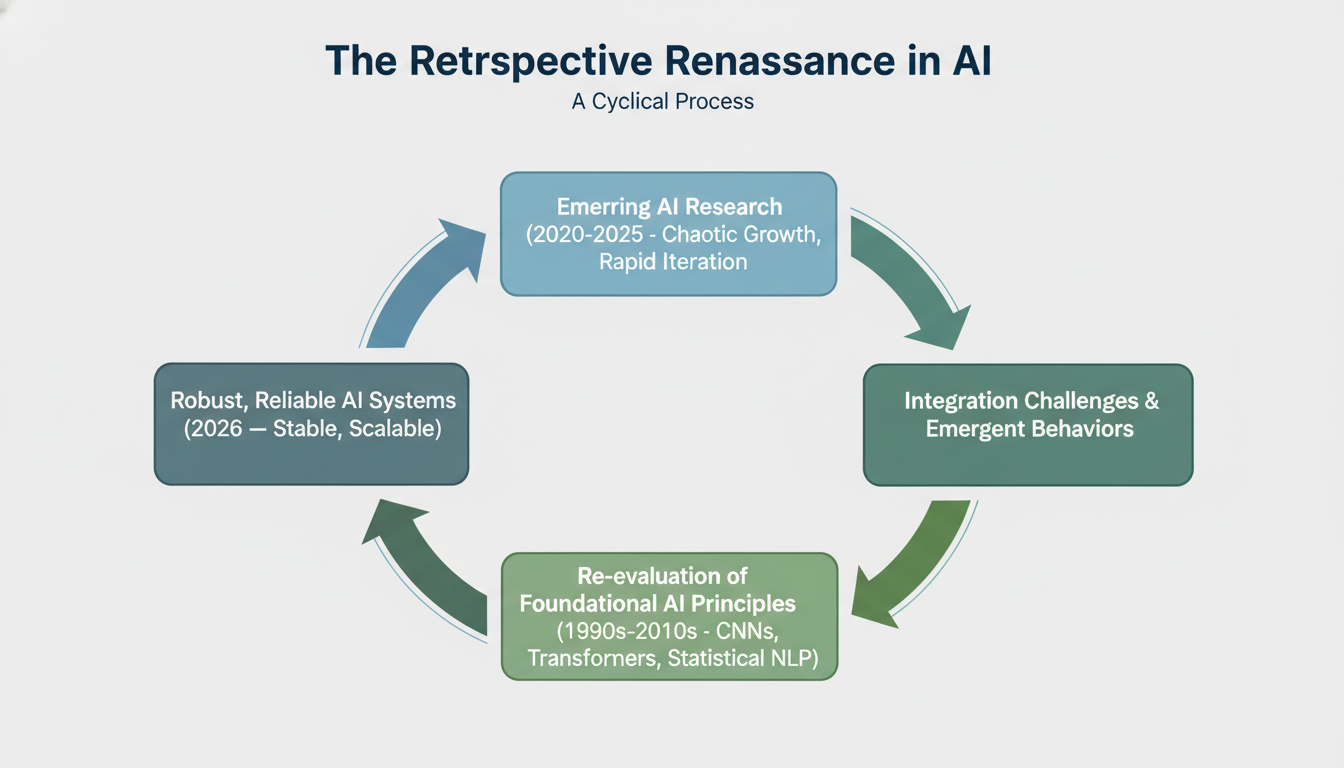
At first glance, this looks like stagnation. Has the well run dry? hardly. This is something far more interesting, and frankly, far more healthy for the industry. After the explosive, chaotic growth of the early 2020s, the engineers have taken over the asylum. We are entering a **Retrospective Renaissance**.
To build the robust, reliable agents we discussed last week, we can't just keep piling more layers onto a shaky foundation. We have to go back and fix the basement. Let’s walk through what the community is reading, and why this "great rewind" is actually the most futuristic signal I’ve seen all year.
---
The Return of the CNN: Vision Efficiency Over Raw Scale
Let's start with a surprise guest. One of the most popular papers circulating this week isn't about Large Language Models at all. It's **"Rethinking the Inception Architecture for Computer Vision,"** a paper by Christian Szegedy and colleagues.
Here is the kicker: it was published in **2016**.
Why on earth are researchers in 2026 reading about the Inception-v3 architecture? To understand this, we have to look at the constraints of the "Generative Agents" we discussed in my last post.
The Optimization Trap
For the last few years, the answer to every computer vision problem was "Throw a Vision Transformer (ViT) at it." Transformers are powerful, general-purpose learners. But they are also computationally heavy. If you are trying to run an autonomous agent on a robot dog, a drone, or even a pair of smart glasses, you cannot afford the compute tax of a massive Transformer for every single frame of video.
This is where the Szegedy paper comes back into play. The Inception architecture was born from a desire to scale up networks without blowing up the computational budget. It introduced the idea of **factorizing convolutions**.
Let's get technical for a moment, because this is beautiful engineering.
In a standard Convolutional Neural Network (CNN), you might have a filter that looks at a 5x5 pixel area. That’s 25 parameters. The Inception team realized you could break that 5x5 filter into two smaller steps: a 1x5 filter followed by a 5x1 filter.
- **Standard 5x5:** 25 parameters.
- **Factorized (1x5 + 5x1):** 5 + 5 = 10 parameters.
They achieved similar geometric understanding with less than half the computational cost.
Why It Matters in 2026
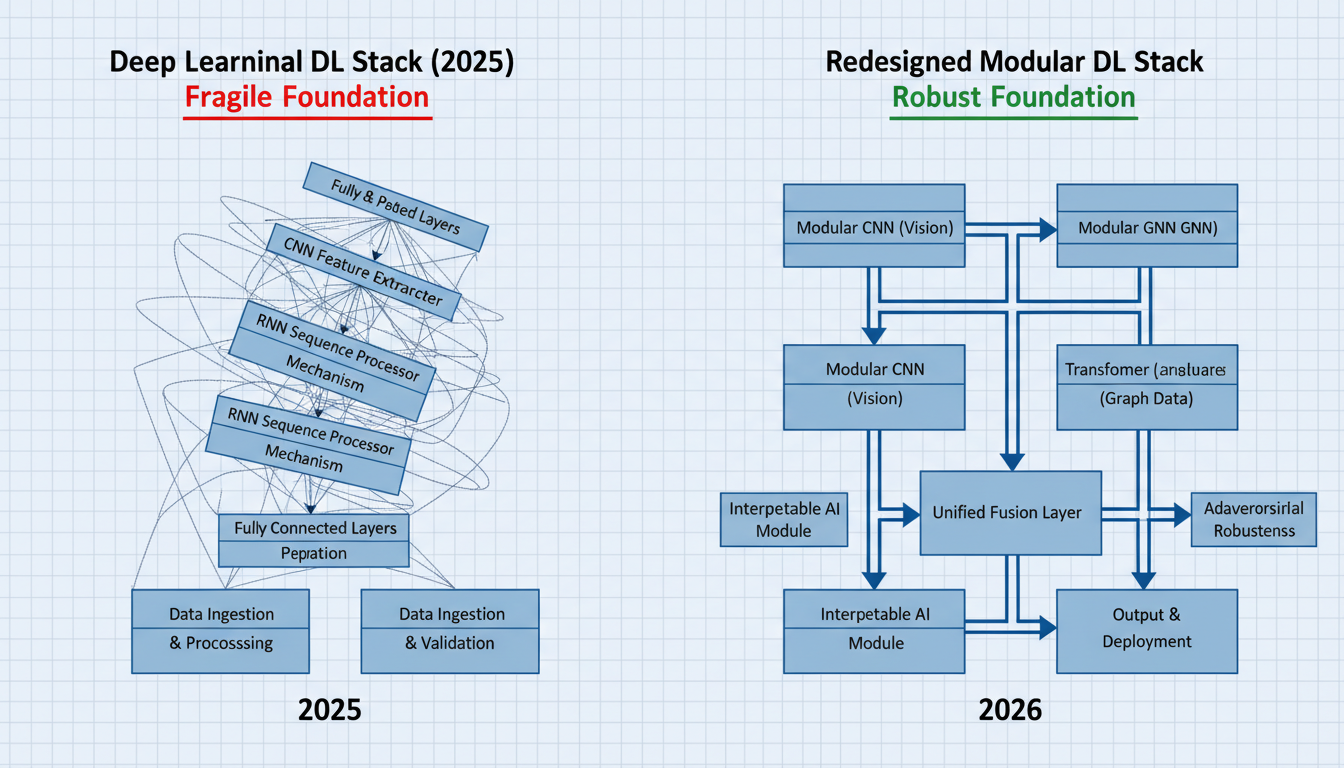
The popularity of this paper, alongside Gu et al.'s **"Recent advances in convolutional neural networks"** (2017), signals a shift in priority. We are moving from "State of the Art accuracy at any cost" to "State of the Art efficiency for deployment."
If we want the simulation to load (as I wrote on Sunday), we need agents that can "see" the world in real-time without needing a dedicated server farm. The industry is looking back at CNNs because they offer a "good enough" vision capability that is vastly more efficient than modern heavyweights. We are relearning how to be thrifty with our compute so we can spend it where it counts: on reasoning.
---
The Roots of Language: Debugging the Black Box
If the return of CNNs is about efficiency, the resurgence of NLP foundations is about **interpretability**.
Another top result in this week's activity is **"Foundations of statistical natural language processing"** by Manning and Schütze. This is a textbook from **1999**. Alongside it is **"Natural Language Processing (almost) from Scratch"** (2011) by Collobert et al.
Why go back this far?
We are currently dealing with the "Hallucination Hangover." We built massive LLMs that speak beautifully but lie confidently. The problem with modern Deep Learning is that it's often a black box—we know *that* it works, but tracing the *why* is incredibly difficult.
The Lost Art of Probability
The 1999 Manning & Schütze text is the bible of **statistical** NLP. Before we had neural networks guessing the next token based on billions of parameters, we had rigid statistical models based on n-grams and Markov chains.
In those systems, if the model said "The cat sat on the... [mat]," it wasn't because of a mysterious "attention head" in layer 96. It was because the probability of "mat" following "on the" was mathematically higher in the training corpus. It was transparent. It was debuggable.
I suspect the sudden interest in these texts suggests that researchers are trying to hybridize modern power with classic reliability. By revisiting the statistical roots, engineers are looking for ways to constrain modern LLMs. They are asking: "Can we enforce statistical guarantees on top of the neural network's creativity?"
It’s the equivalent of a modern architect studying Roman arches. The materials have changed, but the physics of load-bearing structures hasn't. If we want our AI agents to be reliable enough for law, medicine, or engineering, we need to understand the statistical bedrock, not just the neural magic.
---
The Transformer: From Breakthrough to Infrastructure
Of course, not everything is ancient history. The 2020 paper **"Transformers: State-of-the-Art Natural Language Processing"** by Wolf et al. (the Hugging Face team) is also trending high.
But notice the date: 2020. In AI time, that is middle-aged.
This paper isn't researching a new phenomenon; it documents the library that runs the world. The fact that this specific paper is "most popular" tells us about the *audience*. It suggests a massive influx of new engineers entering the field who need to understand the standard model.
The Transformer has become the internal combustion engine of the 21st century. You don't read about it to be amazed anymore; you read about it so you know how to fix it when it breaks. The high readership here indicates that AI engineering has moved from "experimental science" to "trade school."
We aren't just inventing Transformers; we are maintaining them.
---
The Bridge to Now: Prompting as Engineering
While we look back at 1999 and 2016, there is one bridge connecting us to the present day: **"Chain-of-Thought Prompting Elicits Reasoning in Large Language Models"** (2022) by Jason Lee, Xuezhi Wang, and others.
This is arguably the most important paper of the last five years regarding *how* we talk to models. And it connects directly to the "Generative Agents" topic we covered previously.
The Mechanism of Reasoning
Before this paper, we treated LLMs largely as pattern matchers. You put in a question, you got an answer. The paper proved that if you force the model to "show its work" (literally just asking it to "think step by step"), performance on logic and math tasks skyrocketed.
Why is this paper trending *now*, in Jan 2026?
Because we are trying to automate it. We are moving from humans manually typing "Let's think step by step" to building systems where that chain of thought is baked into the architecture of the agent itself.
The "Geometric" Edge Case
This connects to another paper in the current mix: **"Evaluating the Effectiveness of Large Language Models in Representing Textual Descriptions of Geometry and Spatial Relations"** (2023) by Brown and Mann.
This is a fascinating specific deep dive. We know LLMs can write poetry. But can they understand that a triangle with sides 3, 4, and 5 has a right angle, purely from text descriptions?
The findings here are crucial for the physical agents we want to build. If I tell a robot, "Go to the room on the left and pick up the box in the corner," that is a geometric and spatial instruction processed through language. The popularity of this paper suggests that the industry is laser-focused on **grounding**. We are tired of AI that lives in the cloud; we want AI that understands the geometry of the living room.
---
The Outliers: AI Meets the Hard Sciences
Finally, there is a cluster of papers in the search results that seem to have nothing to do with AI at all, yet they are appearing in AI research feeds.
- **"The neighbor-joining method: a new method for reconstructing phylogenetic trees"** (1987)
- **"A new method of classifying prognostic comorbidity"** (1987)
Why are AI researchers reading about evolutionary biology (phylogenetics) and medical comorbidity (disease co-occurrence) from the 1980s?
This is the "Scientific Method" application I alluded to in the intro. AI is being used to reverse-engineer biological trees and predict patient outcomes.
But here is the catch: you cannot train an AI to predict evolutionary paths if you don't understand how biologists construct those trees in the first place. The "neighbor-joining method" is a classic algorithm for clustering genetic data.
AI researchers are downloading these papers because they are trying to beat the classic algorithms at their own game. They are feeding these 1987 methods into 2026 neural networks to see if the AI can find patterns the old algorithms missed. It is a beautiful convergence of silicon and biology, using the literature of the past as the ground truth for the models of the future.
---
The Verdict: Why Looking Back is Moving Forward
So, what do we make of this week's "Time Machine" research report?
If you are a hype-chaser, it looks boring. No new miracles. No AGI announcement.
But if you are a builder, this is the most exciting signal possible. It means the industry is maturing.
- **We are optimizing:** The interest in **Inception (2016)** and **CNNs (2017)** means we are serious about getting AI off the server farms and onto devices. We are prioritizing efficiency over raw power.
- **We are verifying:** The interest in **Statistical NLP (1999)** means we are done with "magic black boxes." We want systems we can trust, debug, and understand mathematically.
- **We are grounding:** The interest in **Geometry (2023)** and **Chain-of-Thought (2022)** means we want AI that can reason about the physical world, not just generate text.
In my post *"The Time Traveler's Guide to AI"* back on December 31st, I noted that the oldest questions are still the newest problems. Today's data confirms that.
We aren't waiting for the next breakthrough. We are currently busy engineering the last one. We are taking the raw, volatile intelligence of the last three years and tempering it with the structural discipline of the last thirty.
The simulation is loading, but this time, we're making sure the foundation is solid before we press play.
Until next time,
**Fumi**

Source Research Report
This article is based on Fumi's research into Last Week's Research: AI. You can read the full research report for more details, citations, and sources.
📥 Download Research Report (Markdown)